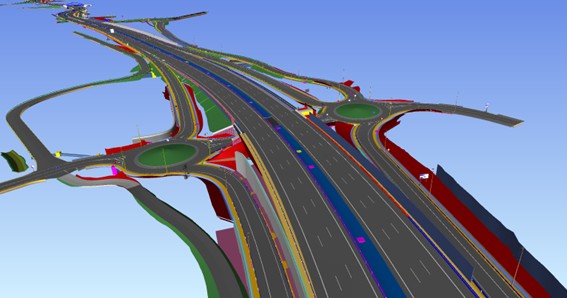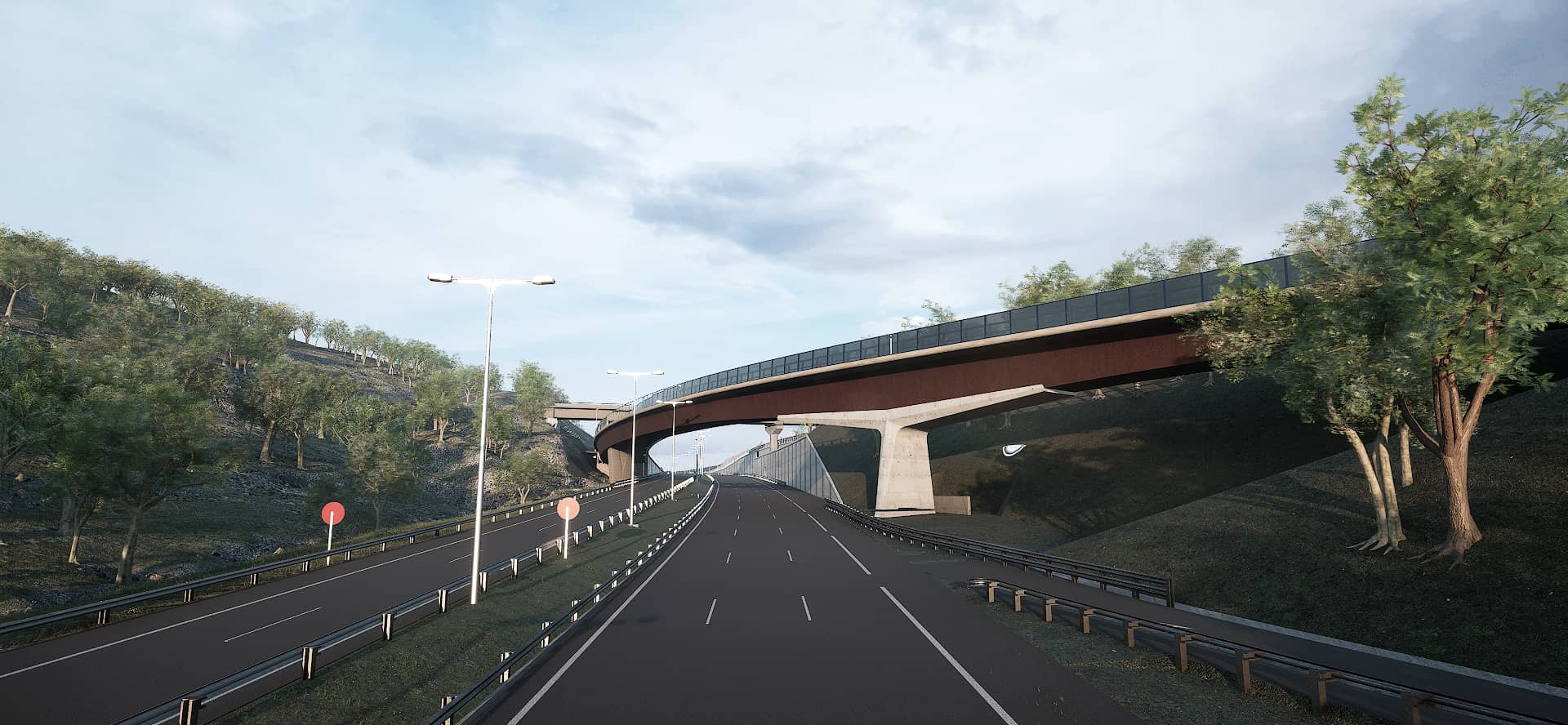


As part of the Ministry of Transport and Sustainable Mobility’s efforts to digitalize its construction processes, INGECID is leading a pioneering pilot project to implement the BIM methodology in collaboration with the Directorate General of Roads (DGC).
The project focuses on the full digitalization of the design and construction of a 12-kilometer highway capacity expansion project, characterized by significant technical complexity due to six interchanges, multiple structures (including retaining walls, overpasses, underpasses, and pedestrian bridges), and a 150-meter viaduct.
During the design phase, several BIM applications are used, including clash detection, automated 2D drawing generation, 5D modeling for quantity take-offs and cost estimation, and 4D scheduling. In the construction phase, additional features are implemented such as monthly certification management, document control through the VIRCORE Common Data Environment (CDE), and the progressive development of an As-built model. A complementary augmented reality model was also created to explore its potential for linear project monitoring.
This project demonstrates in a real-world setting the advantages of BIM for road infrastructure execution: improved coordination, reduced errors, enhanced document traceability, and greater efficiency throughout the construction process.
Media gallery